
KEY TAKEAWAYS
- HELOCs may offer an attractive risk-adjusted return profile relative to other areas of credit. In our view, the asset class’s relative value is driven by its complexity and differentiated position at the intersection of residential and consumer credit.
- The HELOC market is expanding, supported by strong borrower and collateral characteristics. We believe the sector is well positioned for continued growth in a higher-for-longer mortgage rate environment.
- Credit performance, prepayments, and financing costs are central to the HELOC investment opportunity. Stable prepayment behavior provides a more established basis for modeling expected yields, while floating-rate HELOC coupons help mitigate interest rate sensitivity.
- We believe Angel Oak is well positioned to capitalize on this opportunity through our demonstrated experience in residential credit, loan-level borrower analytics, and ability to source and securitize collateral. Recent Angel Oak HELOC securitizations have featured weighted-average borrower credit scores of approximately 740, combined LTVs (first lien and HELOC) of approximately 65% to 70%, and weighted-average coupons of approximately 9% to 11%.
THE EXPANSION OF THE HELOC MARKET
A home equity line of credit (HELOC) is a revolving loan secured by a borrower’s residential property. Unlike a closed-end second lien, which generally provides a borrower with a fixed amount at origination, a HELOC allows borrowers to draw, repay, and potentially redraw funds during a specified availability period. HELOCs are commonly used to finance home improvements, consolidate higher-cost debt, or meet other household liquidity needs.
Although HELOCs and closed-end second liens are often evaluated together, we generally favor HELOCs. Their floating-rate structure limits duration exposure, while their revolving nature introduces additional complexity and creates barriers to entry relative to closed-end second liens.
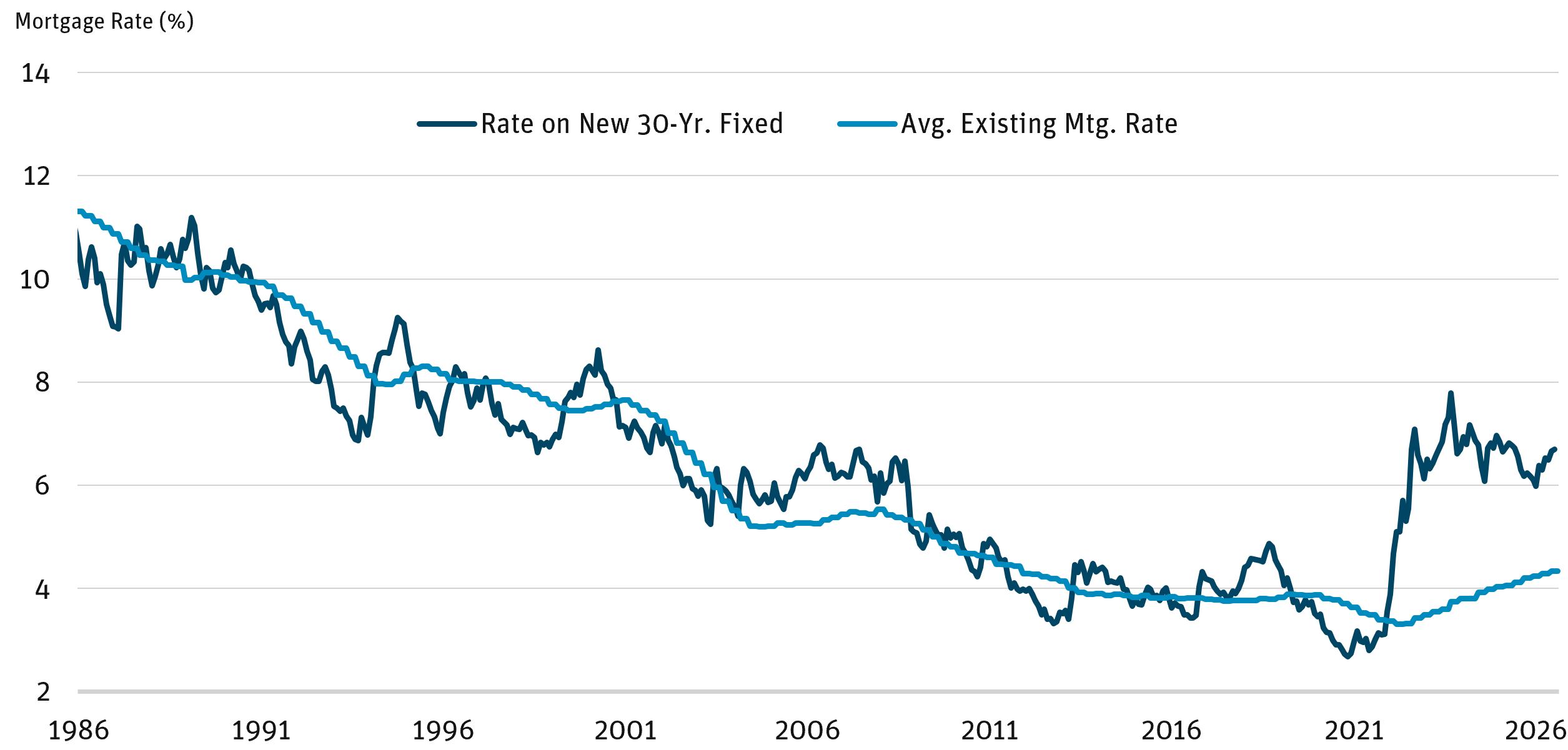
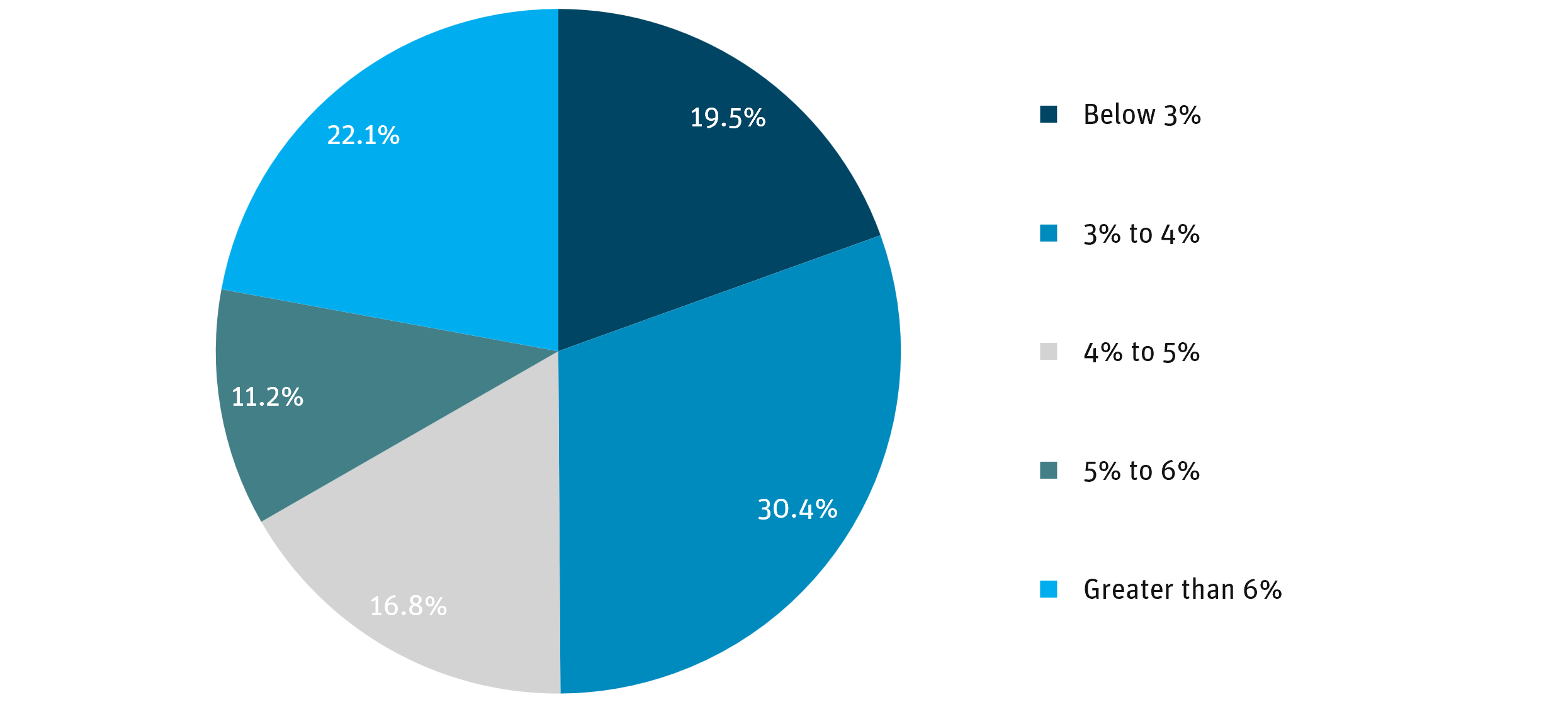
The HELOC market is supported by a structural borrower need. U.S. homeowners have accumulated substantial equity, yet many remain reluctant to refinance first mortgages originated when interest rates were significantly lower (Figure 1). According to the Federal Reserve, U.S. homeowner equity stood at approximately $36 trillion as of June 30, 2026. Federal Housing Finance Agency (FHFA) data also indicates that approximately 67% of outstanding U.S. mortgages carried interest rates below 5% as of March 31, 2026 (Figure 2). This mortgage rate lock-in effect supports demand for HELOCs by allowing borrowers to access home equity while preserving their lower-cost first mortgage.
Figure 1: Mortgage Rate Lock-In Supports Home-Equity Borrowing
Source: Bloomberg as of 6/30/26.
Figure 2: Share of Mortgages Outstanding by Interest Rate at Origination
Source: FHFA, and Macrobond as of 3/31/26.
In addition to the lock-in effect, growth in the asset class is supported by relatively low leverage levels across the housing market. According to the FHFA, approximately 74% of the U.S. mortgage market had an LTV below 60% as of March 31, 2026. The U.S. Census Bureau also estimates that approximately 40% of U.S. homeowners own their homes outright and do not have a first-lien mortgage. Together, these factors suggest continued runway for growth in the HELOC market.
Nonbank lenders serve both agency-eligible and non-QM borrowers, with the non-QM segment in particular funded primarily by private capital. Securitization activity has grown alongside nonbank originations. According to Nomura, HELOC issuance is expected to reach approximately $15 billion in 2026, up from roughly $3 billion in 2023. While the market remains smaller and less mature than established segments such as non-QM, a higher-for-longer interest rate environment has increased investor interest in HELOCs as a complement to other floating-rate securitized products, including collateralized loan obligations.
POTENTIAL RETURN DRIVERS: CREDIT AND PREPAYMENTS
HELOCs can best be characterized as consumer credit supported by residential collateral and homeowner equity. They finance many of the same borrower needs as credit cards, auto loans, and other consumer finance products. The underlying credit support, however, is materially different. Credit cards are unsecured, while auto loans are backed by depreciating collateral. HELOCs, by comparison, are secured by residential real estate and often benefit from a substantial homeowner equity cushion.
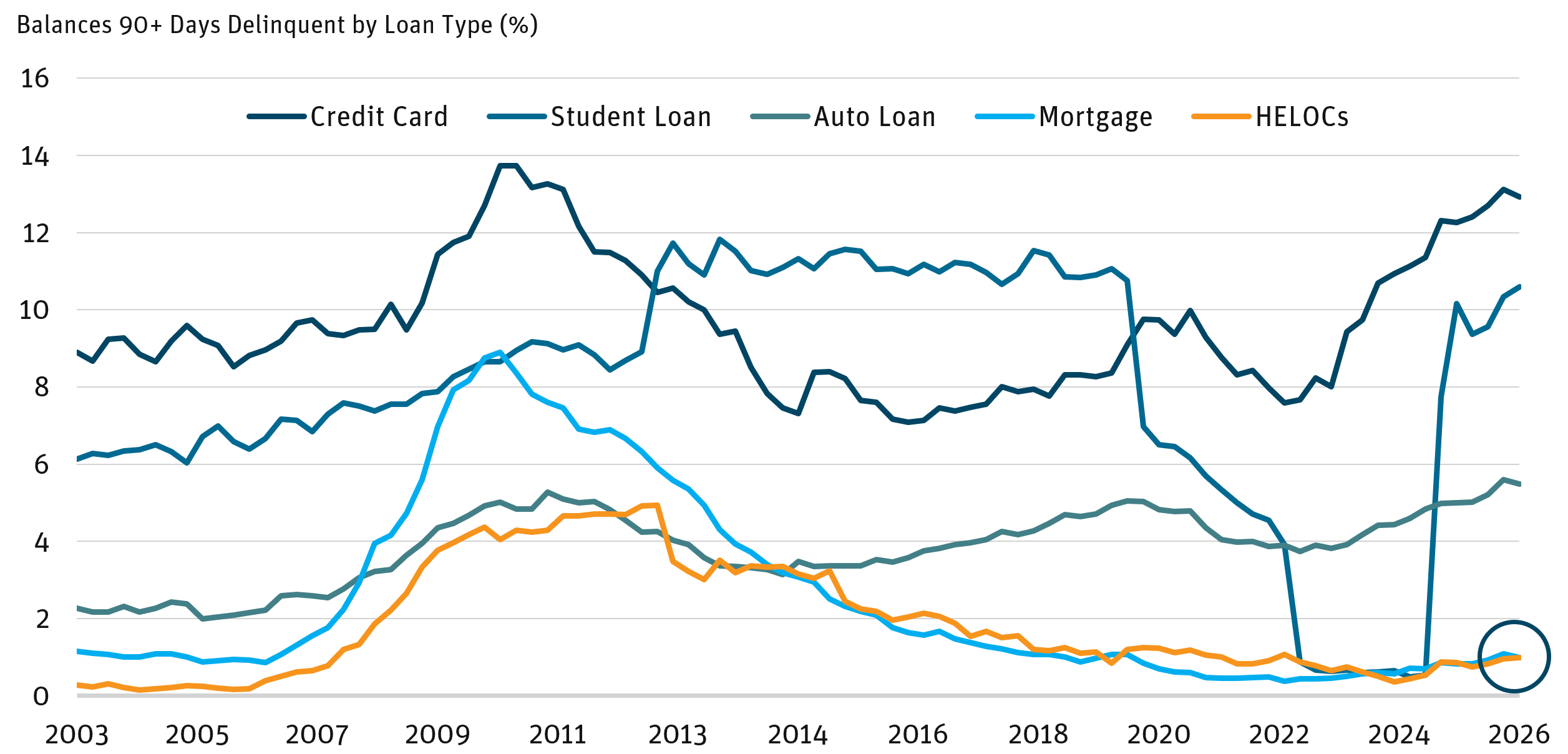
HELOC performance has historically been influenced by both a borrower’s ability to repay and the value of the underlying residential collateral. Recent consumer credit data highlights the differentiated performance of housing-backed credit relative to other consumer lending categories. As shown in Figure 3, loans greater than 90 days delinquent were below 2% for mortgages and home equity lines of credit, materially less than other categories such as credit cards and auto loans.
HELOC securitizations have generally experienced low cumulative losses of approximately 20 to 30 basis points (bps), although reported results can vary across issuers due to differences in servicing and charge off practices.
In addition to credit performance, prepayments are a key driver of returns. Because HELOCs are frequently purchased at prices above par, faster-than-expected repayments can accelerate premium amortization and reduce realized returns. Above-par pricing generally reflects the premium required to compensate originators for origination costs and expected profit margins.
Figure 3: Housing Delinquencies Have Remained Low Relative to Several Consumer Credit Categories
Source: New York Fed Consumer Credit Panel/Equifax as of 6/30/26.
According to Nomura, HELOC prepayment speeds have averaged approximately 25% conditional prepayment rate (CPR) on securitized pools. The higher baseline prepayment speeds observed in HELOCs can be attributed to several factors, including their use as a temporary financing tool for home improvement projects or debt consolidation.
Unlike a closed-end second lien, which provides a lump-sum payment that may take years to repay or refinance, a HELOC functions as a revolving line of credit. Borrowers can draw funds as needed and repay balances over time, often maintaining relatively modest outstanding balances. This flexibility contributes to a more dynamic prepayment profile and further differentiates HELOCs from other forms of residential credit.
HELOC securitizations also benefit from significant diversification due to the relatively small balance size of the underlying loans. This diversification supports the application of the law of large numbers when modeling prepayments and cash flows, improving predictability at the pool level. Lastly, the significant excess spread in HELOC securitizations (difference between cash flows on loans and financing costs) provides resilience even under very fast prepayment assumptions. Taken together, we believe these characteristics support an attractive risk-adjusted return profile for HELOC securitizations.
ANGEL OAK’S EXPANDING HELOC PLATFORM
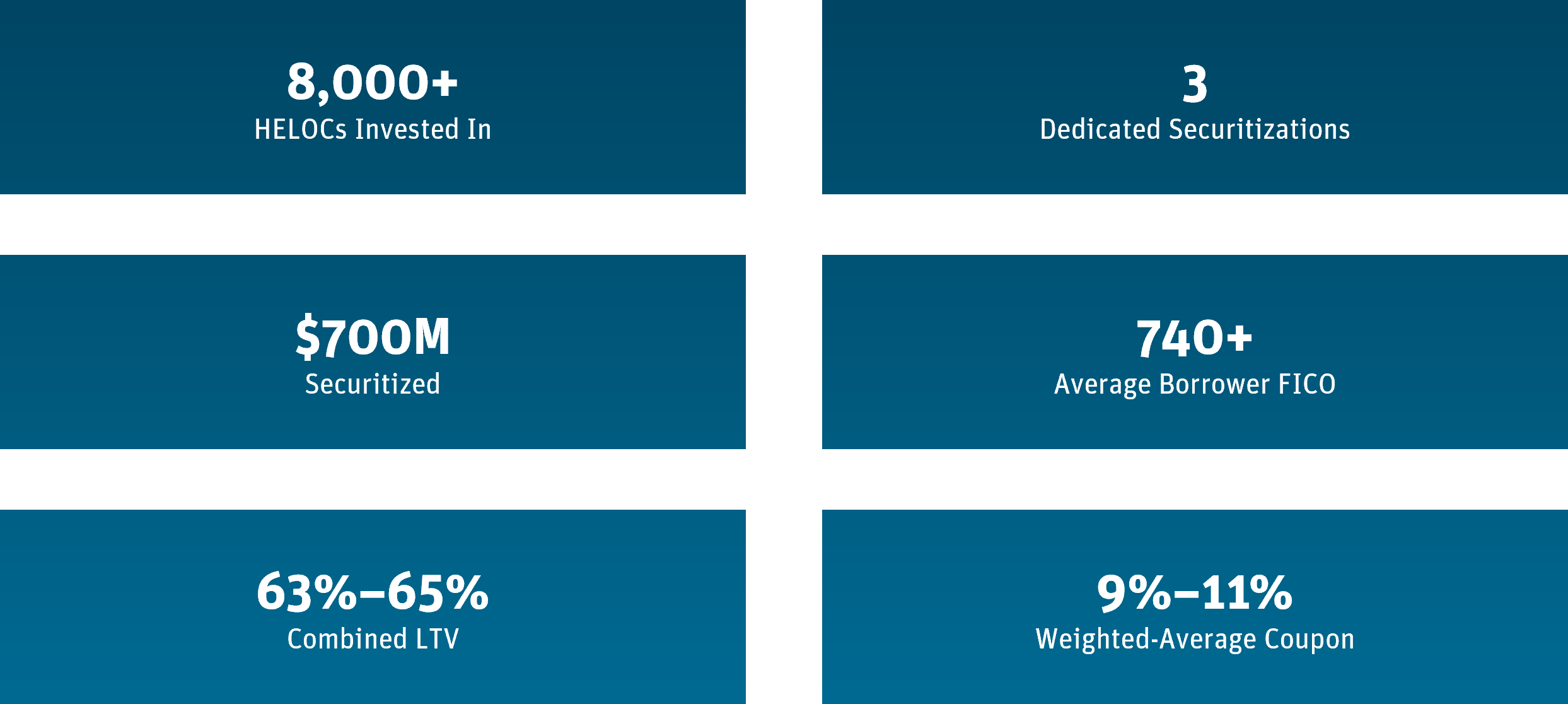
Angel Oak has increased its direct participation in the HELOC market as the opportunity set has expanded (Figure 4). Since 2024, the firm has invested in more than 8,000 individual HELOCs and completed three securitizations totaling approximately $700 million. Recent transactions have featured weighted-average borrower credit scores in the mid-700s, combined LTVs ranging from 63% to 65%, and weighted-average coupons of approximately 9% to 11%.
Source: Angel Oak Capital as of 8/31/26.
Figure 4: Angel Oak HELOC Securitization Experience
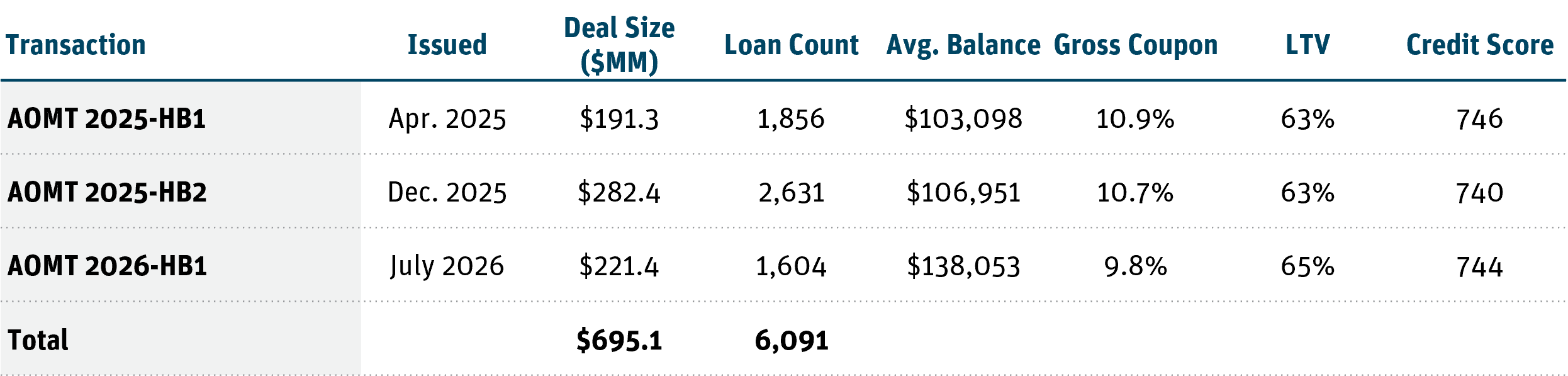
Source: Angel Oak Capital as of 6/30/26.
Investing in HELOCs requires specialized capabilities across sourcing, loan-level analytics, servicing oversight, cash management, and securitization. In our view, successful execution in the asset class depends on developing expertise across each of these disciplines to optimize investment outcomes.
Angel Oak’s residential credit platform integrates affiliate and third-party sourcing, loan-level underwriting, surveillance, financing, and securitization capabilities. This structure provides access to data on borrower draws, utilization rates, delinquencies, and servicing behavior, which can help inform collateral selection and cash flow modeling. The firm’s approach is built around an end-to-end investment process that seeks to capture value through sourcing, underwriting, and the active management of collateral following securitization.
HELOCs are evolving from a predominantly bank-held product into a larger and more broadly financed segment of consumer credit. Borrower demand continues to be supported by substantial homeowner equity and the economic incentive to preserve lower-rate first mortgages. At the same time, origination and securitization volumes have expanded without signs of a broad deterioration in borrower credit quality.
As the market matures, HELOCs may increasingly be evaluated alongside other forms of consumer and asset-backed credit rather than traditional mortgage assets. Supported by residential real estate collateral, substantial homeowner equity, and floating-rate exposure, the asset class has demonstrated a resilient return profile. In addition, the yield profile after securitization may offer compelling relative value compared with other segments of the credit markets.
DISCLOSURES
The views expressed represent the opinions of Angel Oak Capital Advisors, which are subject to change and are not intended as a forecast or guarantee of future results. Stated information is derived from proprietary and non-proprietary sources which have not been independently verified for accuracy or completeness. While Angel Oak Capital Advisors believes the information to be accurate and reliable, we do not claim or have responsibility for its completeness, accuracy, or reliability. Statements of future expectations, estimates, projections, and other forward-looking statements are based on available information and management’s view as of the time of these statements. Accordingly, such statements are inherently speculative as they are based on assumptions that may involve known and unknown risks and uncertainties. Actual results, performance, or events may differ materially from those expressed or implied in such statements.
All investing involves risk, including the loss of principal. There is no guarantee that investment objectives will be attained. Results may vary. There is no guarantee that risk can be managed successfully.
This document does not constitute advice or a recommendation or offer to sell or a solicitation to deal in any security or financial product. It is provided for informational purposes only and on the understanding that the recipient has sufficient knowledge and experience to be able to understand and make their own evaluation of the proposals and services described herein, any risks associated therewith, and any related legal, tax, accounting, or other material considerations. To the extent that the reader has any questions regarding the applicability of any specific issue discussed above to their specific portfolio or situation, prospective investors are encouraged to contact Angel Oak Capital Advisors or consult with the professional advisor of their choosing.
Except where otherwise indicated, the information contained in this presentation is based on matters as they exist as of the date of preparation of such material and not as of the date of distribution or any future date. Recipients should not rely solely on this material in making any future investment decision.
These investment strategies are speculative and involve substantial risks, including the risk of loss of an investor’s entire investment, which an investor should be willing to accept. No assurance can be given that profits will be achieved or that losses will not be incurred. Investment performance may be adversely affected by market, economic, political, regulatory, or social developments, as well as changes in interest rates, credit conditions, liquidity, and capital market environments. Credit risk is the possibility that debt issuers may fail to make timely principal and interest payments or experience deterioration in credit quality.
Investments in HELOCs and HELOC-related securities involve additional risks. HELOCs are generally second-lien obligations and are subordinate to first-lien mortgages. In the event of borrower default, recoveries may be limited and losses may be greater than those associated with first-lien mortgage loans. HELOC performance may be adversely affected by borrower credit deterioration, declining property values, economic conditions, and prepayment rates that differ from expectations. Actual prepayment rates may differ materially from expectations and could adversely affect investment returns.
Past performance is no guarantee of future returns. No guarantee of investment performance is being provided, and no inference to the contrary should be made.
Angel Oak Capital Advisors is a registered investment advisor. However, registration as an investment advisor with the SEC does not imply approval by the SEC or that the advisor or its employees possess a certain level of skill or training.